

The State filed its charges. What does the discovery say?
Analyzed Discovery is a zero data retention system. When the run ends, the architecture removes all of your supplied data from all systems, everywhere. No human has access to your files, not at Analyzed Discovery, not at any vendor, no one.
Analyzed Discovery.
The attorney supplies discovery media. The Engine finds the initial call for service and traces the facts through police contact, detention, searches, evidence collection, arrest, and transport. It compares police reports, affidavits, declarations, witness statements, interrogation transcripts, video-derived output, photographed objects, historical records, and forensic reports to identify overlaps, anomalies, omissions, and load-bearing facts. It then tests the Government’s claims of illegality and corroboration and applies analytical leverage to the vulnerable joints where its facts meet the law.
Analyzed Discovery is a zero data retention service. Read the Privacy Policy.
The Engine produces a 23-section report:
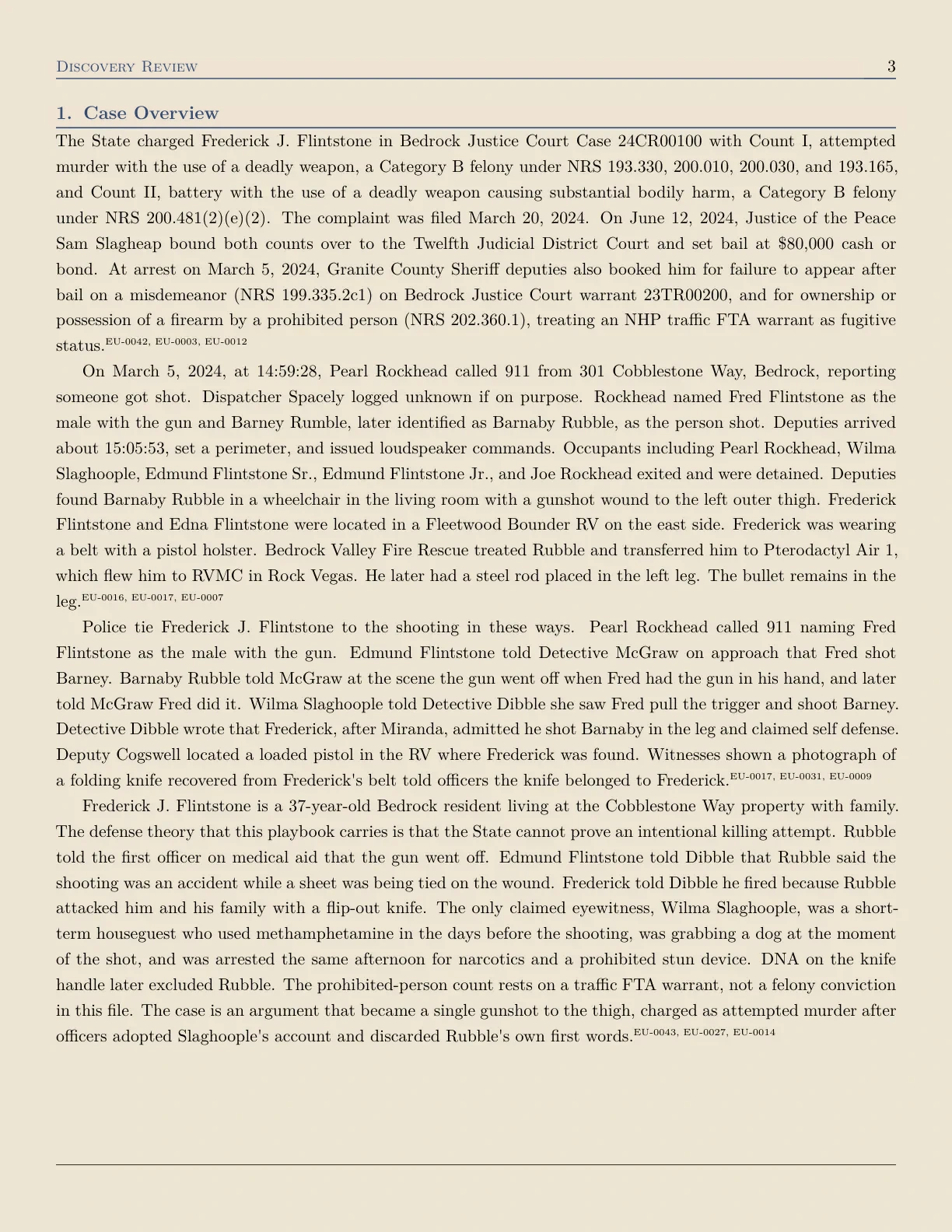
- 01Case Overview Extracts the charges and their statutes and lists the police and civilian actors and their individual roles in the case.
When the discovery contains a coherent factual account, even if partial, the Engine will usually identify the prosecution’s available theories of the case.View section in Example #1 and Example #2. - 02Timeline Reconstructs the sequence of events from temporal information in the supplied record, with references to the supporting material.View section in Example #1 and Example #2.
- 03The Initial Report & 911 Calls Examines the initial report and any 911 calls, including who called, what was reported, and factors bearing on the reliability of each account.View section in Example #1 and Example #2.
- 04Dispatch & Radio Traffic Compares what dispatch relayed to officers with information in the record.View section in Example #1 and Example #2.
- 05Arrival on Scene Compares recorded arrival times with officer accounts and describes the scene as reported.View section in Example #1 and Example #2.
- 06Identification of the Defendant Traces when the client became a named suspect and how the identification was made.View section in Example #1 and Example #2.
- 07The Initial Encounter Analyzes first contact and identifies where the encounter may have become a seizure.View section in Example #1 and Example #2.
- 08The Detention Analyzes the length of any detention and whether and when it may have become custody.View section in Example #1 and Example #2.
- 09Interrogation & Statements Analyzes statements under Miranda and voluntariness standards.View section in Example #1 and Example #2.
- 10The Search Analyzes the scope, consent, and warrant authority for the searches described.View section in Example #1 and Example #2.
- 11Arrest & Booking Analyzes probable cause at the time of arrest.View section in Example #1 and Example #2.
- 12Evidence Anomalies & Contradictions Titled function.View section in Example #1 and Example #2.
- 13State Constitutional Protections Applies state protections that go beyond federal standards to the facts of the case.View section in Example #1 and Example #2.
- 14Evidentiary Issues & Pretrial Motions Works through the rules of evidence (relevance, other-act and character evidence, authentication and foundation, impeachment) and identifies motions in limine that may address each issue.View section in Example #1 and Example #2.
- 15Missing Evidence Identifies missing evidence that should exist according to the supplied record.View section in Example #1 and Example #2.
- 16The Defense Narrative The Engine walks through the supplied facts and provides a defense narrative.View section in Example #1 and Example #2.
- 17Alternative Theories Presents alternative theories of the case and evaluates the support for each.View section in Example #1 and Example #2.
- 18Mitigation Presents information from the record that may be relevant to mitigation.View section in Example #1 and Example #2.
- 19Outcome Assessment Rates each motion against the evidence and authorities developed in the report and ranks the motions by those ratings, using the same scoring in every case.View section in Example #1 and Example #2.
- 20Action Plan Lists possible motions, discovery requests, and investigation steps, ordered by expected impact, for counsel to consider.View section in Example #1 and Example #2.
- 21Objectivity Review Reviews the investigation for indications of confirmation bias, tunnel vision, and early assumptions.View section in Example #1 and Example #2.
- 22Case-Strength Scorecard Scores issues developed in earlier sections and shows the calculation.How the Scorecard worksView section in Example #1 and Example #2.
- 23Coverage Verification Reports which source files were processed and how evidence units were accounted for.View section in Example #1 and Example #2.
- EIEvidence Index Links findings to numbered evidence units and indexes each unit to its source document.View section in Example #1 and Example #2.
Section 22 Scoring
Section 22 scores the issues with a formal additive model. The model, its derivations, and the analysis of every permitted rating profile are set out in a methods article.
Each developed defense issue receives four values. These are a reference position for its issue type, a rating of evidentiary support, a rating of the forum and controlling authority, and a bounded contextual adjustment. Their sum is the issue index. A logistic transformation maps that index to a 0–100 scale. A consequence-weighted mean of the issue indices summarizes the case. The report links each rating to its evidence units and shows the arithmetic.
The paper derives the model’s properties symbolically and checks them across all 5,508 permitted rating profiles. It measures the rankings’ dependence on the declared type positions. Across 11,376,774 cross-type comparisons, removing the structural adjustment reverses 5.27% of pairwise rankings; removing all type adjustments reverses 20.19%. It also establishes that the displayed score can change by no more than 25 points per unit of index and identifies the conditions under which dividing an issue leaves the case summary unchanged.
The score ranks issues under the stated rule. It does not represent a probability of acquittal, and 50 does not mean even odds. Inter-rater agreement and correspondence with judicial outcomes remain empirical questions. The paper proposes a study using 50 development cases and an independent test set of 500.
Findings point to the documents you supply.
Run the State’s production as delivered, or change it. Add hypothetical facts, alternative accounts, or new material, or leave items out. Attorneys are encouraged to test the record any way they choose. Each fact carries an evidence-unit number tied to the document it came from, whatever was supplied, and a coverage section shows how the files were handled.
How to check a findingYour file. Your judgment.
Access requires a bar number. The analysis is material for counsel’s review and iteration. What to supply the Engine and every other decision remain with the attorney.
Privacy & Security